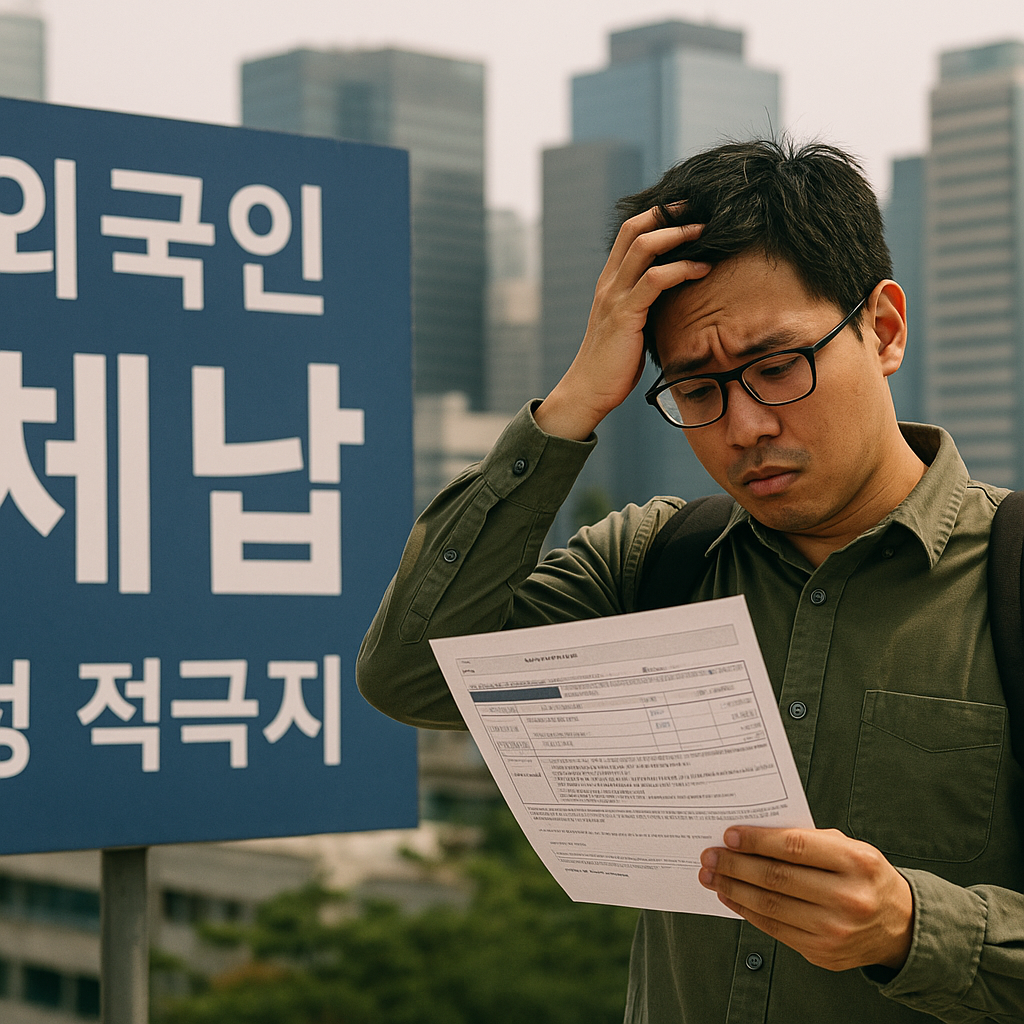
Who is affected
Foreigners’ unpaid taxes in Seoul can arise when a resident misses a filing, underreports income, or leaves a tax notice unresolved. The issue may concern national taxes administered by the National Tax Service (NTS), local taxes collected by Seoul or a district office, or both.
Individuals, employees with additional income, landlords, freelancers, and owners of foreign-owned businesses may be affected. Tax residence is a legal classification based on facts such as residence, domicile, and economic connections, and the commonly applied 183-day test is relevant but is not the only consideration (National Tax Service Korea).
A person can remain liable after changing address, leaving Korea, or transferring business operations abroad. This article explains the basic rules, documents, deadlines, filing steps, possible consequences, and points at which professional advice should be obtained.
Rule and effective date
Korean tax liability generally arises from taxable income, transactions, property, employment, or business activity rather than from nationality alone. A foreign resident may therefore need to review Korean-source income and, depending on residence status and the applicable treaty, income from outside Korea.
For an individual, the annual global income tax return is generally filed from 1 May through 31 May for the preceding tax period, subject to the applicable filing category and official instructions. A taxpayer who misses the deadline may still file voluntarily, but the unpaid amount can increase through additional tax and late-payment charges (National Tax Service Korea).
Employees whose tax has been fully settled through year-end payroll reconciliation may have no separate annual filing for that employment income. Additional business, rental, investment, or foreign income can change that result, so a review of Income Tax guidance is important.
Value-added tax (VAT) applies to taxable supplies made by a business, while withholding tax may apply when a Korean payer makes certain payments. VAT returns commonly follow 25 January and 25 July deadlines for the relevant reporting periods, and withholding tax is generally reported by the 10th day of the following month, but the notice and taxpayer category control (National Tax Service Korea).
Documents and deadlines
The first practical step is to identify the tax type, taxable period, tax office, and payment reference shown on the notice. Do not assume that a Seoul address means every liability is a Seoul local tax, because national and local authorities use different systems and notices.
- Identity and status: passport, Alien Registration Card details, Korean address history, and immigration records where relevant.
- Income evidence: employment statements, withholding receipts, invoices, contracts, bank records, rental records, and overseas income documentation.
- Business records: business registration, sales and purchase invoices, expense evidence, payroll records, and account statements.
- Prior communications: tax returns, payment certificates, assessment notices, collection notices, and correspondence with the tax office or district office.
Keep original records and reliable translations where documents are not in Korean or English. A business should also retain accounting and payroll evidence for the statutory retention period applicable to the record, rather than discarding documents after payment.
| Item | Typical timing or measure | Point to verify |
|---|---|---|
| Annual individual income tax | 1 May to 31 May | Whether a special filing period or extension applies |
| VAT reporting | Often 25 January or 25 July | Business type, taxable period, and filing status |
| Withholding tax | Often by the 10th of the following month | Payment type and payer obligation |
| Resident tax and other local taxes | Deadline stated by the local authority | Seoul or district office jurisdiction |
Filing process
Start by checking the unpaid balance through the relevant NTS or local-government channel and confirm whether the amount is an assessment, a self-reported tax, or a collection notice. The notice date matters because objection, payment, and instalment procedures can have separate deadlines.
- Confirm the taxpayer identification details, tax category, taxable period, principal tax, additional tax, and payment deadline.
- Collect income, expense, withholding, residence, and business records for the period under review.
- File the missing return or correction through the available electronic or paper procedure, using a Korean tax representative where required.
- Pay the balance through an approved payment channel and retain the receipt or payment certificate.
- Contact the issuing office if the account remains open, the amount appears duplicated, or payment cannot be matched.
Electronic filing may require identity verification, a Korean certificate, or access to the taxpayer account, and language support can be limited. A foreign-owned business should coordinate tax records with payroll and employment records, because errors involving employees can also raise Labor Law compliance issues.
When a taxpayer cannot pay the entire amount at once, the taxpayer should ask the authority promptly whether an approved payment arrangement or other collection measure is available. An informal promise to pay does not automatically suspend collection, interest, enforcement, or reporting obligations.
Penalties and exceptions
Additional tax is not a single universal charge, and the result depends on the type of failure, the taxpayer’s conduct, the tax, and the statutory calculation. Korean tax materials distinguish, among other categories, late filing, underreporting, and deliberate concealment, with commonly cited rates of 20 percent for certain late filings, 10 percent for certain underreporting, and 40 percent for certain fraudulent conduct (National Tax Service Korea).
Late-payment charges can accrue by reference to the outstanding amount and the legally applicable daily rate, with NTS guidance commonly presenting 0.022 percent per day for relevant periods. This figure should be checked against the current notice and applicable rule because rates and calculation methods can change (National Tax Service Korea).
Voluntary correction, prompt payment, genuine uncertainty, force majeure, and documented administrative error may affect relief or penalty treatment in limited circumstances. They do not automatically cancel the principal tax, and a taxpayer should not assume that leaving Korea or closing a business removes liability.
Serious arrears may lead to collection measures, restrictions connected with official administration, or information relevant to immigration review, depending on the facts and governing procedures. Tax debt should not be treated as a routine Visa Law issue, but a person with an extension, status change, departure, or re-entry concern should obtain case-specific confirmation from the Ministry of Justice and the tax authority.
Official source links
The NTS provides English-language information on Korean tax administration, filing, payment, and taxpayer services. The Ministry of Justice provides immigration and stay-related information, but its guidance does not replace a tax assessment or a payment instruction issued by the NTS or a local authority.
- National Tax Service Korea — tax administration and English taxpayer information.
- Ministry of Justice Korea — immigration, residence, and justice administration information.
- Finance — related financial information for record-keeping and payment planning.
Use the official service or office identified on the notice before relying on a general online explanation. Screenshots, payment receipts, filing confirmations, and written replies should be retained together in a dated compliance file.
When to obtain professional advice
Professional advice is prudent where several years or tax periods are involved, records are incomplete, income was earned in more than one country, or the person has both employment and business activity. It is also advisable when a notice alleges fraud, a bank account or asset is subject to collection, or a filing may affect a corporate officer or employee.
A qualified Korean tax professional can assess residence, treaty treatment, amended returns, penalty relief, and payment arrangements, while a lawyer can address objections, enforcement, immigration consequences, or disputes. Before engagement, confirm the adviser’s qualifications, scope, fees, confidentiality terms, and authority to communicate with the relevant office.
Get in Touch
Have questions about your specific situation? Reach out anytime for a personal consultation.